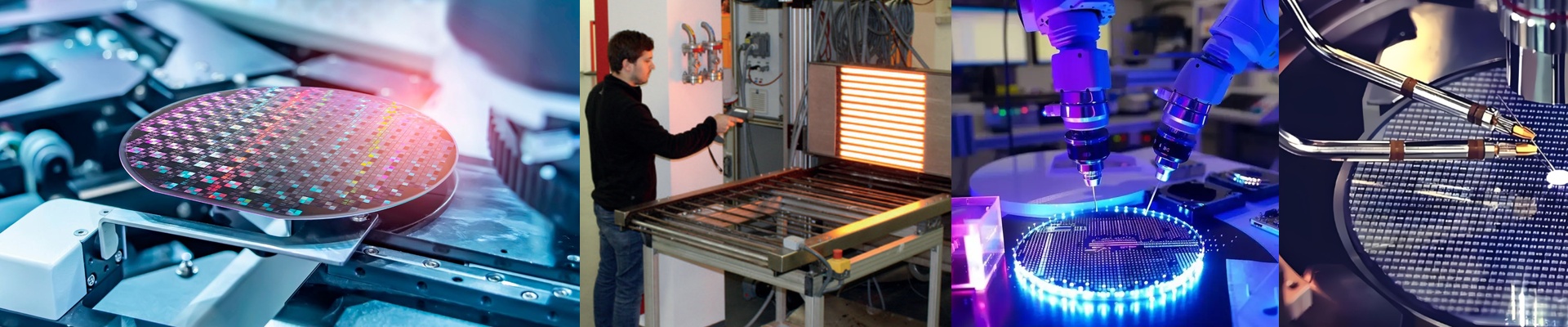

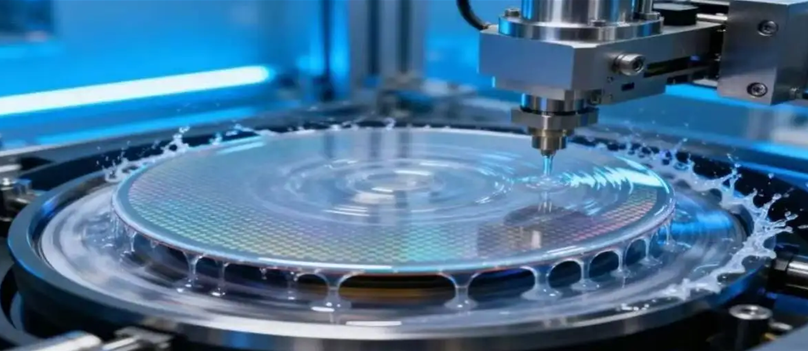
On the OLED line, you don’t get any margin. A soft bake that drifts even 1°C shifts the photoresist profile. A hard bake without uniformity will quietly eat yield. And in a 7×24 fab, the drying step isn’t a pause. It’s a constraint that has to hold, hour after hour.
What matters, technically
We built the OLED manufacturing drying lamp around repeatable heat and clean delivery. Short-wave halogen elements give fast response and tight thermal control. The quartz envelope and reflector geometry hold wafer-level uniformity to ±0.1°C across the bake zone. It’s compatible with Class 1–100 cleanrooms, and the design produces zero particle events during operation. Particle counts stay in spec without adding filtration overhead.
Why it works in practice
The lamp hits the real pain points in lithography and photoresist processing: consistent soft bake, stable hard bake, and predictable drying that keeps critical dimensions under control. In OLED stacks, you have to pull out moisture and solvents completely—without overheating sensitive layers. That translates into fewer rework lots, tighter CD distribution, and process windows that don’t shrink on you. Units run 5,000+ hours with less than 5% output drift, so you can keep running without unplanned stops.
What you need to know
Installation comes down to matching the lamp to chamber geometry and airflow. Thermal uniformity depends on positioning and shielding. Expect a short commissioning run to tune the setpoint profile across substrate types. The lamp performs best when voltage stays within ±2%. And always calibrate the bake recipe to actual wafer temperature, not just the setpoint. Plan changeouts around preventive maintenance windows so you don’t trip the line.