
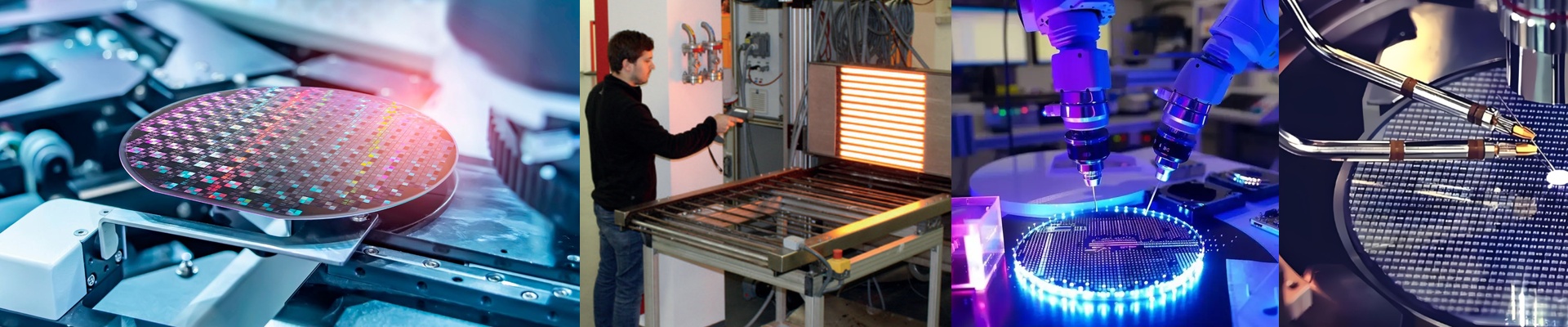
On the fab floor, a 0.1°C drift during the photoresist bake can shift a linewidth by nanometers—and wipe out hours of lithography work. In high-volume wafer manufacturing, thermal repeatability isn’t a “nice-to-have.” It is the process. We designed our ultra-precision thermal systems to keep every soft bake and hard bake inside the thermal budget, day after day, across Class 1–100 cleanrooms. Here’s what matters under the hood. Our halogen-free heating modules hold ±0.1°C steady-state uniformity across the wafer, and that setpoint stability holds up under 24/7 duty cycles. NIR short-wave response gives you sub-second ramp control, cutting thermal lag and protecting thin-film integrity. Cleanroom-compatible materials and zero particle generation keep contamination counts down, and the system meets SEMI safety and EHS requirements. Energy draw is tuned to the process window, not peak demand, so you run more bakes per kilowatt-hour without sacrificing temperature accuracy. In lithography, photoresist processing is where yield is won or lost. We keep soft bake solvent removal consistent and hard bake adhesion repeatable, so critical dimension control stays in spec. The payoff: fewer rework lots, tighter CD distribution, and cycle times you can plan around. For packaging lines, that same thermal stability translates to reliable curing and bond integrity—fewer scrap wafers and fewer unplanned stops. Global supply chain integration means the system drops into existing fab infrastructure, fitting major equipment footprints and interfaces. A few practical notes before you sign off. High accuracy means disciplined installation. Plan for cleanroom-rated power, grounding, and exhaust, and make sure your recipe’s ramp rates are within the controller’s tuning limits. The platform is built for continuous operation, but you’ll need routine calibration every 5,000+ hours to keep that ±0.1°C performance.Match the heater to the chamber geometry—mismatched thermal masses will eat into uniformity.
반도체 제조 현장에서는 포토레지스트 베이크 시 0.1°C의 온도 편차만으로도 라인폭이 수 나노미터 단위로 변동되어 수시간의 리소그래피 작업이 무효화될 수 있습니다. 대량 웨이퍼 생산 환경에서 열 반복성은 선택 사항이 아니라 공정의 필수 조건입니다. 당사는 Class 1~100 클린룸 전반에 걸쳐 매일 소프트 베이크와 하드 베이크가 설정된 열 예산 내에 유지되도록 초정밀 열 시스템을 설계했습니다.
핵심 기술 사양은 다음과 같습니다. 할로겐 프리 가열 모듈은 웨이퍼 전면에 대해 ±0.1°C의 정상 상태 균일도를 유지하며, 이 설정 안정성은 24시간 연속 운전 조건에서도 유지됩니다. NIR 단파 대응은 1초 이내 램프 제어를 가능하게 하여 열 지연을 줄이고 박막의 무결성을 보호합니다. 클린룸 호환 소재와 무입자 발생 설계로 오염도를 최소화하며, 시스템은 SEMI 안전 및 환경·보건·안전(EHS) 기준을 충족합니다. 에너지 소비는 최대 수요가 아닌 공정 조건에 최적화되어 킬로와트시당 베이크 횟수를 늘리면서도 온도 정확도를 유지합니다.
리소그래피 공정에서 포토레지스트 처리는 수율을 좌우하는 부분입니다. 소프트 베이크 시 용매 제거를 일관되게 유지하고 하드 베이크 시 접착력을 반복 가능하게 관리함으로써 중요 치수(CD)의 공차 내 제어가 가능합니다. 이로 인해 재작업 로트 감소, CD 분포 집적도 향상, 계획 가능한 사이클 타임 확보가 가능합니다. 패키징 라인에서는 동일한 열 안정성이 신뢰성 있는 경화 및 접합 무결성으로 이어져 스크랩 웨이퍼 감소 및 예기치 않은 생산 중단을 줄입니다. 글로벌 공급망 통합으로 기존 팹 인프라에 원활히 장착되며 주요 장비 치수와 인터페이스에 적합합니다.
마지막으로 설치 전 실무 참고 사항입니다. 높은 정확도를 위해 엄격한 설치 규율이 필요합니다. 클린룸 등급 전원, 접지, 배기 설비를 계획하고 레시피의 램프 속도가 컨트롤러 조정 한계 내에 있는지 확인해야 합니다. 플랫폼은 연속 운전을 위해 설계되었으나 ±0.1°C 성능 유지를 위해 5,000시간 이상마다 정기적인 교정이 필요합니다. 히터는 챔버 형상에 맞춰 선택해야 하며, 열 질량 불일치는 균일도 저하를 초래합니다.